Showing posts with label twine. Show all posts

Monday, April 11, 2016

They grow up so quickly

Just a couple of weeks after appearing from their slumber it's time to start training the bines up their helical path via some new twine wrapped around bamboo poles, much like last year:


This also means it's time to select which I think are the strongest shoots and trim back the rest. The Columbus is again coming out the stronger of the two that are left (I've pretty much given up on seeing the Willamette again):


After some thinning out:


Thinning will come to the Cascade when it is ready:


The rhizome I transplanted at the bottom of the garden is also showing signs of life:


The hop shoot risotto wasn't attempted this year due to pretty underwhelming results last year. Even the raw shoots when picked directly from the plants don't really taste of anything. Perhaps different strains of hops are used in the parts of the world where hop shoot risotto is prepared.

Wednesday, April 22, 2015

You turn your back for a couple of weeks (but more so this year)

Have been out of town for the past couple of weeks (much like last year). Main difference is this year we're a couple of weeks later in the year. When I left there were just a couple of shoots appearing that were just a few inches long. Getting back I was greeted by this sight:


Amazing just how much growth you can get in such a short period of time. They were even picking fights with the poor tulips that are just trying to flower:


Unfortunately, despite all this growth there is still no sign of the Willamette. This is all I found where it should be:


Pretty sure this is just a tomato volunteer from the compost and as such has been discarded.

In previous years I have initially used tomato cages and then strung twine up to the window above. The hope was that they would provide some shade during the hotter summer months. The amount of shade actually provided was quite pitiful so I'm trying a different method this year for corralling them. The plan is to use four bamboo poles per plant and string up the twine around them in a helix fashion. I'm afraid I don't remember where I first saw this arrangement otherwise I would give a reference. Fortunately, we have a wooded trail near us that has a couple of stands of bamboo that are constantly being cut down as they try to invade everything else. From here I dragged out several lengths which were further cut in half:


One of the nice things about bamboo is that it is very easy to work with. The only real problem is convincing it not to split. To ease embedding in the ground I cut angles off the bottoms:


Come the zombie apocalypse I'm making bamboo spears! Once completed it was a matter of making holes in the raised bed with a crowbar and then stabbing downwards with these newly sharpened poles:


The idea with this arrangement is that harvesting will be a lot easier as I will hopefully have managed to grow up to 30 feet of hops with only 8 feet of bamboo pole. All being well I should be able to do the harvesting from the upper reaches of the plants with just a small set of steps. Next up is twine. This year it occurred to me to try and make measuring their heights a little easier by marking 5 foot lengths in the twine with knots:


This way I only need measure to the nearest knot to work out how tall they are. Next step is winding the twine around the poles in a helical fashion. Obviously this alone will not ensure it stays put so I decided to staple them in place each time they go around a pole:


I appreciate there's a chance putting staples in like this might result in splitting of the bamboo. No sign of that yet but I will be keeping an eye out for it. Worst case scenario, I'm sure splits can be dissuaded from spreading further with gaffa tape. Final step is just to gather hops and train them along the twine. Here's the Columbus:


And the Cascade:


As the twine is not even close to being arranged vertically (what the hops would prefer) there will be a need for pretty much daily supervision to make sure the bines are sticking to the twine. In previous years this hasn't been a problem at all as I still get a kick out of having plants grow several inches per day. During the peak growing period there is a noticeable difference in height between the morning and evening. I'm also hoping that my Willamette will make an appearance this year even though it wasn't looking very happy at the end of last year. There's always the possibility that it has been squeezed out by the other two plants though. As always, only time can tell. I don't really want to go poking around in the earth looking in case I do some damage to shoots that are just about to appear.

Thursday, April 24, 2014

Onwards and upwards

Growth over the last couple of weeks has been prodigious with the Columbus and Cascade getting towards the top of their respective tomato cages:
 

Hopefully the three Columbus shoots and one Cascade shoots that are getting close can be seen. This means that it's time to instigate my twine-based plan for further upward growth. Unfortunately, some bodging will be necessary as there are no obvious points from which to hang twine. My intention is to string them up to the window just above them, thus creating some shade underneath (if we get enough growth):


What I hope is visible here is a small piece of bamboo that has been inserted into one of the holes of the brick forming the window sill. There is a similar hole on the other side. I drilled small holes in each of the bamboo pieces so that I could string some twine between them. They are kept in place by keeping the twine between them under tension through knot tying. The idea is that lines of twine can then be attached to the twine between the two pieces of bamboo. There is one attached in the photo above. Adding a total of nine lines (3 for each plant) looks like this from below:


And like this from the side:


And this is the full frontal:


I'm hoping that with enough growth, particularly from the Columbus, that there will be enough shade created so we can move the glass table (you can see in the side view) underneath to take advantage during the summer. Only time will tell how much growth happens. Certainly, putting up this arrangement has happened just in time for the Columbus:


My only real concern now is stopping them from growing up the string of lights. There will have to be some hyper-vigilance given how quickly they are growing right now.

Saturday, June 29, 2013

Cones, bugs and falling down.

My first hop cones have appeared! Good news indeed for the Columbus:


They're not fully formed yet but those hairy looking buds sticking out will become cones in the fullness of time if all goes well. There is also some sign on the Cascade of upcoming coneage:


These are only buds at present so may well turn out to be more leaves but I can keep my fingers crossed in the meantime. No sign on the Willamette as yet. There's still time (I keep telling myself).

Not everything has been going my way though. I have recently found what I think is a Japanese beetle on the underside of a leaf of the Columbus:


Identifying this bug was made easier because of the research I did last year trying to identify a June bug. This is the first time I've seen one but I suspect not the first time I have seen its handiwork:


I have a feeling they are likely to be as voracious as June bugs, so I will be treating them with extreme prejudice. Needless to say this one will not be bothering my hops again. On a slightly brighter bug note I have seen several of these guys:


Here's a slightly better view (if you look closely):


These white, fluffy, little guys are ladybird larvae (I hope):

The larvae, just like the adults, are pretty keen on eating other pests, so I'm more than happy to leave them be. Can't really see them taking down an adult Japanese beetle so I may have to deal with those myself.

Something that has been a wee bit of a mystery was one morning finding the twine holding up some of the Columbus cut and the growth from the shepherd's hooks lying on the ground. Seems no real damage was done, fortunately. The mystery is how it (twine on the left) was severed:


Perhaps that bit of twine just had a weakness. We had had very heavy rainfall overnight so that may have been the cause, although we have had similar rainfall since without anything similar happening again. The other possibility is that a bird did indeed decide to try and use it as a perch with the very obvious outcome. Anyway, I have tied some knots and strung it up again:


This time, to make my life easier, I've looped the twine over the upper iron hook and tied it to the lower one. This way I don't need a ladder to reach it. It has survived our most recent storms so fingers crossed it'll hold and the bird that got a shock when it tried to land on my twine has learned its lesson. The other birds are probably still making jokes about it needing to go on a diet.

Friday, June 21, 2013

String theory

The slightly cooler weather and rain have meant that I haven't had to give my hops much in way of attention in terms of watering or similar. As a consequence the Willamette and Cascade are getting close to the shepherd's hook they have been strung up to:


To head them off I have put up what should be the rest of the twine. I will be very impressed if more is needed:


This is looking from behind the hooks towards the poles on the other side of the garden. I have intentionally crossed a couple of the lines with a mind to maximising the potential for creating shade. It's quite possible I will have to be careful to make sure that they continue to grow straight along the twine they start on, otherwise it's likely going to be easy to get confused as to which is which. I have also arranged one line to be above the other that it is crossing. As you may or may not be able to tell, there has been some sagging of the first line I put up (on the far left) so I don't know if this will solve the problem.

The sharp-eyed amongst you will notice that the pole on the right does not have the handy metal spikes that I used to attach the twine to on the other pole. What I've done is a bit of a bodge but will hopefully keep the twine in place for the rest of the summer:
 

What I've done is use heavy duty staples. I've also folded the twine back on itself several times and stapled it each time. I reasonably certain it will hold the hops, not sure what will happen if the birds decide it looks like a nice perch. Hopefully the twine is too thin for them to entertain that particular idea.

The Columbus is still looking very bushy and healthy:


Something of a contrast to the Willamette and Cascade which are looking a little thin in comparison. This is reflected both in the total height of growth but also the number of secondary shoots that have appeared to thicken it out.

With regard to whether growing in a left or right handed helix has any discernible effect, here's the evidence so far:
 

The shoot furthest to the right is growing in a right handed helix, the one behind it in a left handed helix and the one behind that in a right handed helix. I certainly have not been able to tell any difference in them. They all seem very happy to be just getting on with growing. Perhaps they have an intrinsic preference but aren't really all that fussy about it. Pragmatists of the plant world, or weeds as some might call them. Hard to tell really.

Monday, June 17, 2013

Twist and crop

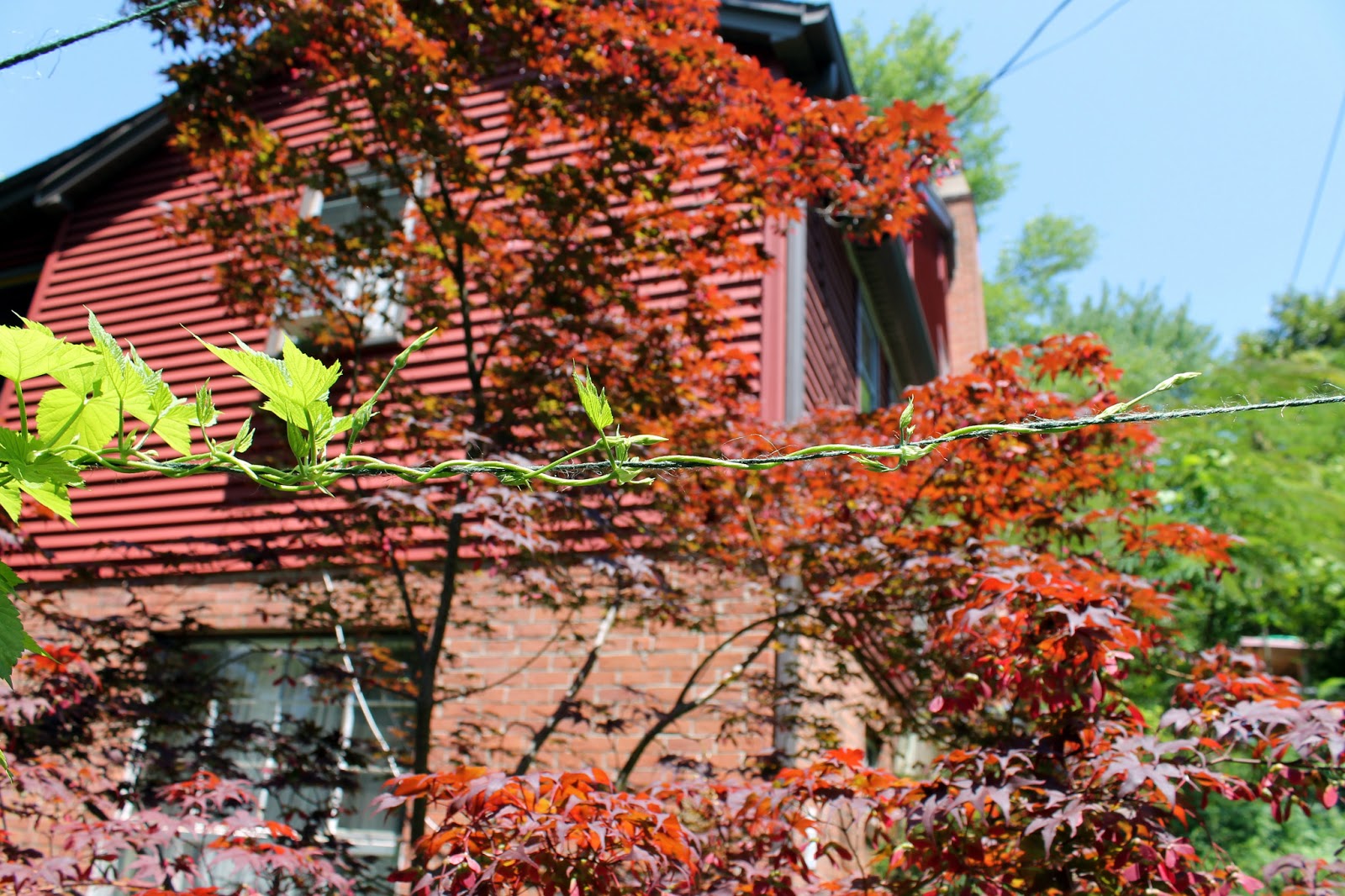
I've given the Columbus several days to start to look as if it was going to wrap around the twine I've set up crossing the garden. Days may not sound like a long time for most plants but then for hops that's several inches growth. Here's what the Columbus looked like this morning:


As you should be able to see, it's making no real effort to wind around the twine. I guess I could leave it to flail around for longer but it would probably end up finding the maple behind rather than the path laid out for it.

You'll also be able to see that there is a second shoot coming up behind it. I've decided, being a scientist at heart, that I'm going to conduct a small experiment. According to this source, hops grow with an intrinsic handedness. As I'm going to have to wind them around the twine myself, I may as well see if I can perceive any difference between shoots from the same plant growing in either a left or right handed helix:


The source above claims that hops are intrinsically left handed. In the pic above the furthest along shoot has been wound in a right handed helix, while the one behind it is in a left handed helix (I think). You can check for yourself here. We'll see over time if there is any perceptible difference between hops forced to grow against their better instincts.

This all reminds me of this article, talking (a little pedantically if you ask me) about popular depictions of DNA using the wrong handed helix. The picture they chose to use is of course not a great representation of DNA either though. I'll leave it to the molecular biologists amongst you to decide what's wrong with that picture. I guess this is just an example of the curse of the pedantically inclined (one I have fallen foul of on plenty of occasions): you can look a little foolish if you don't get everything right if you're going to point out how others have got it wrong. It's very possible though that the author was not responsible for choosing the image.

Just to be thorough, here's where the Willamette and Cascade are in comparison, growing in what I think are the as-advertised left-handed helices:


The Cascade is the nearer one and looking as if it too will need to be trained across the garden soon. They are both looking a little thin in comparison to the Columbus though. It's hard to tell at this point whether this is normal growth and the Columbus is just exceptional or if these two are struggling.

Friday, June 14, 2013

Because it's there

It was only a matter of time, and not very much at that. The Columbus has now reached the top of the twine stretching from the tomato cage to the shepherd's hook. This means that I have had to implement the next stage of construction. This will hopefully set the stage for some shade over the rest of the summer. I have now stretched some twine over to the poles opposite:


The pic above also gives you an idea of how well the Columbus is doing. Here's the same thing from the side:


Hopefully you can see the twine sloping upwards to the right. You should also be able to see that the bird feeder has been moved over to a hook on the pole too (the one below where the twine has been attached). The cat insisted on being in this one and who am I to turn him down. He'd probably dig something up just to spite me if I didn't include him anyway.

As well as being the tallest, the Columbus is also looking very bushy, with loads of secondary shoots coming out at all levels. On more than one occasion I have had to dissuade it from climbing the maple:


Here's the Cascade, looking thinner and slightly bug-eaten (if you look closely). The new leaves are also visibly much paler in comparison to older ones (this is normal though as far as I can tell):


The Willamette certainly hasn't given up, but is a little way behind. It seems to have taken a while to recover from having it's apical meristem lopped off by some nefarious bird (allegedly):


And this is what the whole lot looks like head on:


Note how the lower hanging basket on the left has been taken over by sunflower seedlings. This and the damage caused by birds landing on the tomato cages were contributing factors in the moving of the bird feeder.

At this point I'm very much hoping that further growth along the twine will happen without any more intervention on my part. My experience last year in Houston with the growth along the balcony leads me to suspect that I will have to give it a helping hand. If that is indeed the case I might be tempted to see what happens when a shoot is forced to grow along a helix of opposite handedness to that which they would normally follow.

Sunday, June 2, 2013

String 'em up

Despite the best efforts of the birds, as noted in the last post, the time has come to start putting twine up for further climbing. Hopefully the birds have been rendered less lethal now that the tomato cages have been cable-tied. I've now put some twine between the tops of the cages and the tops of the shepherd hooks:


With any luck you can see three lengths of green twine. I will attach more as it becomes necessary. All three plants have gotten to this stage. Here's the Columbus:


Which also wins the prize for being the bushiest:


All four verticals will at some point need twine over to the hooks. The Cascade is next bushiest:


With two of the verticals being used to great effect. It also seems to have been the quickest to recover from being decapitated by our avian visitors:


There are two new shoots visible growing out of the highest part possible. There's also some great secondary growth further down:


The Willamette, however, clearly has a very different strategy to the others. While it has put some effort into secondary growth at the top:


It's pretty paltry compared to what it's done lower down:


The Willamette seems to be very much more single minded in its efforts to climb. This is reflected in it being the least bushy of them (I'm discounting the Galena completely at this point):


This particular strategy may well prove its undoing if there are any further threats, like bird decapitation. Right now the Columbus is very much looking like the most successful of the lot. It's only just started getting hot here so there's obviously a long way to go yet.