Showing posts with label Hop cones. Show all posts

Monday, September 7, 2015

Skip forward to harvest time

This summer has been a very busy one. Various other responsibilities (including a new job) have left me with very little time to keep up with this blog. Fortunately, my hops can look after themselves to a great extent, especially with an automatic drip watering system in place. I was able to take a picture for the weekly overview and I've put the progression down the right hand side of the web-version. You can see from these that both plants do very little growing over August and September. Can't really blame them though, it's been very hot here (even the grass has stopped growing).

The whole reason for growing hops is to have cones that can be harvested and put in beer. The first cones appeared at the end of May:


This is in a very early stage of development. My understanding is this is the stage at which they may be pollinated if there are male plants in the vicinity. As with last year, the Columbus produced both male:


And female cones (you can see some male flowers in this pic too):


I have yet to see any indication that there has been any successful pollination happening, either with itself or the Cascade which is right beside it. Some of this is presumably due to the timing, the male flowers always appear after the female flowers (on both plants) are no longer in the receptive "burr" stage.

The final result of all this growth and cone formation was this:
 

12oz of Columbus and 1oz of Cascade were vacuum sealed and thrown in the freezer. Shame that the Cascade proved to not be very productive this year. Perhaps this will improve once it has established itself more. Alternatively, the Columbus may just push out all of the competition. The Willamette has been almost absent this year. Here's what it looks like at the start of September (you might just be able to see it growing up along the string of lights to the right):


One of the nice things about having a nano operation like this is that I can get more than one harvest per year. While I was picking these first cones I saw this on the Columbus:


Which led to this second harvest (close to another 5oz of Columbus):
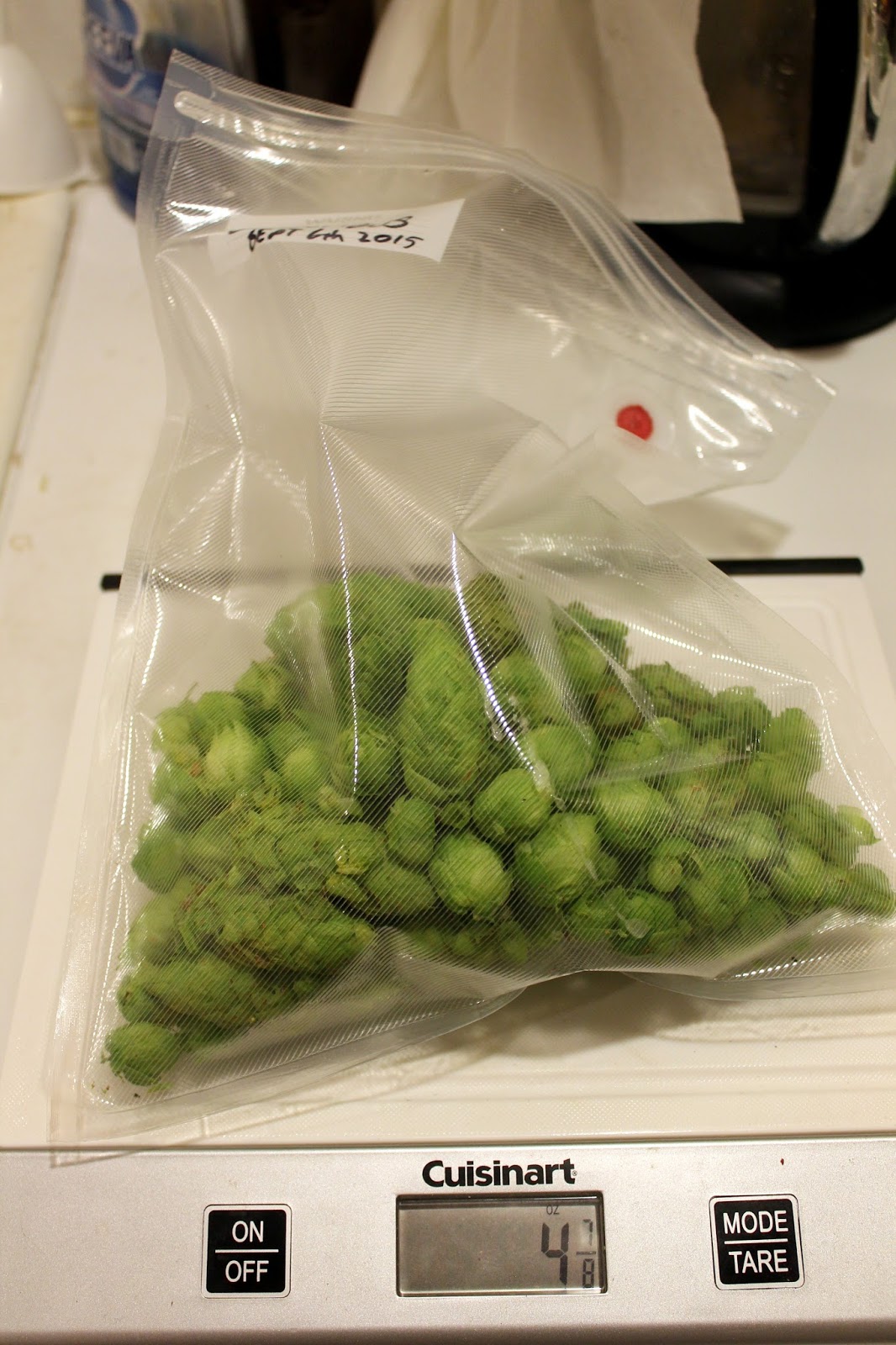

Looking forward to putting these into some beer later in the year.

Bugs have caused as much of a problem as they did last year, which is to say not enough to make a noticeable difference to the growth of the plants. Here's a typical example of the worst kind of leaf damage I've seen:


Anybody following from my days in Houston might remember I had previously found a tobacco hornworm on our tomato plants next to my hops. Same thing happened this year too, only with a worse outcome for the hornworms:


This rather gruesome end comes thanks to a parasitic (Braconid) wasp that lays its eggs inside the worm. When the eggs hatch they eat the hornworm from the inside. When the time comes they chew their way through the skin and form a pupa on the outside (those small white things hanging from the worm). Not entirely sure how they convince the hornworm to grip the underside of the plant like that but then I'm also not entirely sorry for them either.

Now we are into September there are signs that Autumn may be on its way. The Cascade, which has always been less productive in comparison to the Columbus, already has some bines that have died off:


The Columbus also has some signs of the oncoming autumnal purge, even if not quite as dramatic as the Cascade:


All told the summer appears to have been much less productive compared to last year. The Columbus gave me a ~1lb this year compared to nearly 2lbs last year, the Cascade a handful of cones vs nearly 2oz last year, and the Willamette barely even appeared and didn't produce any cones at all. I'm wondering if this is due to neglect on my part or perhaps the extreme heat of this summer. I don't remember the grass stopping growing altogether last year. All of this after the extreme cold of last winter. I had to entirely cut back a pair of well established fig trees that didn't make it through the cold. Obviously, I'm leaning towards the climate being the problem, especially given that we used an automatic drip system this year which should have taken a lot of the neglect out of the equation. Hopefully the coming winter will be milder and the following summer kinder. Regardless, I will still be using what I've gathered for a fresh hopped beer of some description in the coming months.

Monday, August 4, 2014

You can't keep all the hops happy all of the time

My Cascade is not very happy at all. It has stopped producing new cones altogether. There are still a few left on it that I hope will continue to mature. The weird thing is that the plant doesn't appear to be suffering that much, particularly in comparison to the Willamette beside it (on the left):


As you may be able to see, the Willamette is producing a huge number of cones despite not looking very happy. I have found a few dead and withered shoot tips on the Cascade recently though:


We have had something of a dry spell recently. It's quite possible I was not fastidious enough about keeping them watered. As neither the Columbus nor Willamette are showing similar symptoms, I wonder if my Cascade is just more sensitive to drying out. The cones that are left on the Cascade still look healthy (even if those particular leaves have been attacked slightly):


There is new growth on the Cascade, so I'm hopeful that it will make a full recovery:


The Columbus is going nuts in comparison, with new cones forming all the time while the older ones continue to mature (looking forward to harvesting more):


In the last few days we have of course had a good amount of rain. I think I will need to make a concerted effort to keep an eye on how much rain we're getting and water accordingly.

Tuesday, July 29, 2014

Horton hatches the cone

I have previously seen what I thought was an assassin bug in amongst my hops, particularly the Columbus. For the past couple of weeks there is one that has remained on station in the same spot:


I think I have now identified this as a juvenile wheel bug that hasn't yet developed the characteristic wheel on its back. Staying patiently in one place like this immediately made me think of Horton hatching an egg:


The big difference being that instead of waiting for an egg to hatch, it's waiting for another bug to come along so that it can stab it with its beak and inject digestive enzymes that will liquify it from the inside which can then be sucked out. Yum! The intention may be very different but it is always in the same spot every time I look. I just hope it's getting enough to eat. Never thought I'd be coming over all maternal for an assassin bug. As Dr Michael Raupp of the U. of Maryland is quoting as saying on the Wikipedia entry: "They're the lion or the eagle of your food web. They sit on top. When you have these big, ferocious predators in your landscape, that tells me that this is a very healthy landscape, because all these other levels in your food web are intact." Needless to say, I'm feeling a little better about my efforts at organic hop farming.

Just so as to update where the hops have gotten to. The Columbus has come on with an extra growth spurt, despite producing what I thought was a terminal cone previously. As you can see from this pic, it has reached the top of the twine available and is starting to just fall back down. Fortunately, it hasn't grown over to where the Cascade is, as that would make telling them apart a lot more complicated. You can also see that cone production has continued vigourouly despite my earlier harvesting:


The Cascade has also continued to produce cones after earlier picking:


The Willamette is producing a huge number of cones but they are some way from being ready for harvesting. They also look as if they will be ready at roughly the same time, in contrast to the other two plants:


Not bad for a plant that was pretty stingy last year.

Overall, there appear to be a lot of cones to look forward to in the very near future. Fresh hop beer awaits.

Monday, July 21, 2014

On complicated sex and harvesting

Last year I saw some smaller cones on my Columbus around the time I harvested. I had hoped they would turn into a second harvest but had to move them and that stopped that dead. I have seen them again this year:


Doing some reading this year I found this piece that clearly states that these are in fact male flowers. I had known previously that hops are dioecious, that is they have two sexes. What we think of hop cones are the flowers found on the female plant. The presence of male plants nearby is not desirable as there is a chance of pollination and subsequent formation of seeds within the female flowers which are not something we want in our beer. What I had not know was that some strains of hops are "triploid" and can thus have both male and female flowers. The above article specifically names Columbs (as well as Zeus) as an example of a "triploid" hop variety.

"Triploid" means that the plant has three copies of each chromosome, in contrast to us humans who normally have just two copies in most of our cells ("diploid"). The exception to this rule being our gametes, which have half the normal number (ie one of each, that is referred to as haploid). In contrast, plant genetics can get very weird and complicated very easily. Some crops (such as strawberries and sugar cane) can be up to octoploid (8 copies of each chromosomes).

The above article is written by the head hop grower at Great Lakes Hops and she says that male flowers in Columbus appear when the plant is severely stressed. This year has been a bit dryer and hotter than last year but I don't think they could be described as "severely stressed". Certainly last year it did not appear to be stressed at all and there were a good number of male flowers. However, last year they did only appear after all of the female cones had developed. This year, with a bit more stress, I have seen them appear much earlier. Perhaps this is sign to make sure I water them more regularly. I have mostly been relying on our weather so far this year, which has provided plenty of rain but not at regular intervals.

Although there are some signs of stress this year, it doesn't seem to have affected the production of cones much. I have already started harvesting some from the Columbus:


And Cascade, with plenty more to come:


The cones on the Willamette are not yet ready to pick but there are plenty of them:


This is just one lateral arm. If you remember last year, this is a plant that gave me a whopping total of three cones. I'm particularly pleased with this as the plant itself does not look overly happy in comparison to the others:


I am hopeful that I will be able to continue picking hop cones for several months to come. If I'm very lucky I might even get an increase in production in relation to last year. The Willamette is certainly set to give me a lot more than its first year.

Friday, June 6, 2014

First major infestation and other mystery die-offs

I found the first signs of a significant infestation today. Here's what I spotted initially from above:


Underneath I found these guys going about their evil doing:


Needless to say I removed the leaf immediately, which is why it's on our outdoor table rather than still on the plant. They were subsequently disposed of. I didn't find any evidence of them being on any of the other leaves but will be keeping a very close eye on things.

I also noticed this somewhat mysterious dying-off of some of the lateral, secondary shoots on the Columbus:


As there is a very neat distinction between the dead & dried part vs the green & alive part I'm hoping that this is a case of the plant deciding to concentrate its efforts on forming cones further up the plant. All of the dead lateral buds I found like this are lower down than the newly forming cones on this particular bine. There are a good number of cones forming though:


These are the cones that have developed the most so far. If my harvest only includes the cones that are visible now I will still be happy. The other bines of the the Columbus have yet to produce any so I am hopeful I will be getting a lot more. The same is true for the Cascade and Willamette. There is still plenty of growing left to be done this year so I'm in no hurry.

Thursday, May 29, 2014

Terminal cone

So in previous years I have noticed that my hops get to a certain height then decide that they've grown far enough and produce a cone on the apical meristem, which is the origin of vertical growth. In Houston this happened at the start of July and last year here in Maryland it was closer to the end of July. The Columbus has already produced an apical cone on the tallest of the shoots and we're still in May:


As with previous years, I'm hoping this will mean that the rest of the plant will begin to fill out and hopefully produce more cones as a consequence. There are already a lot forming on the Columbus:


There's currently no sign of cones (let alone terminal ones) forming on the Cascade:


Or Willamette:


I guess this means that they haven't stopped growing vertically yet. There is still plenty of growing time left this year so I am still very hopeful the Cascade and Willamette will end up being more productive than last year in terms of cones.

I'm really not sure what determines the height hops grow to. It seems to me that at less than 14 feet tall the Columbus is somewhat short of what would be considered normal growth, especially for commercial growers. Perhaps I've ended up with a dwarf variety somehow. It's also possible that they are not getting enough water. I have only actively watered them once so far this year as (I feel) we have had plenty of rain so far. It is also possible they are just not able to transport water any further up the stem than this. I have a vague memory from a botany class a very long time ago that plants rely on evaporation through the stomata in the leaves to achieve transport of water up from the roots. If this is the case I can see that living in an environment with high humidity (such as we have here) would make this more difficult and thus limit vertical growth. This would also explain why (relatively arid) Eastern Washington state is an ideal growing area for them. There may well be a trade off though between having the plant putting energy into vertical growth versus cone production. What is the ideal point for switching from one to the other?

The shorter stature may well make it easier to harvest, so no complaints from me on that front. My biggest concern is successfully getting cones from these plants that I can use in my beer. I suspect the reason for the apical cone appearing earlier this year has a lot to do with these being in their second year of growth and are thus much more vigourous. The Cascade and Willamette still have over a month to produce an apical cone if they are to stay on the same timetable as previous years so I'm not worried at all. I'm still quietly confident that this year will provide an increased harvest compared to last year.

Wednesday, September 25, 2013

Brewing pt2

In this particular case I'm using a recipe kit from Austin Homebrew, their Kalamazoo IPA. This kits comes with pelleted Centennial hops which I will be using along with my own hops. The vast majority of the hops I have harvested are Columbus, which are normally used as a bittering hop as they have a high alpha acid content. However, it is unlikely that my own homegrown hops will have achieved such high levels of alpha acid, especially in their first year. I'm also not going to spring for a lab analysis. For these reasons I've decided to split them up, half (about half a pound, wet weight) going in at the start of the boil (as bittering hops would) and the other half going in 15 minutes before the end of the hour (along with the meagre offerings from the other two hops) to contribute to the flavour. Here's the first lot going in:


I poured them in straight from the freezer. This is what they looked like after a couple of minutes:
 
The smell at this point is amazing. I always enjoy brew day for the way it makes the house smell but using fresh wet hops always makes it that much more so. As I said earlier, I added the rest of the hops towards the end of the boil. All three Willamette cones (bless their hearts):


As well as 2oz of Cascade:


And the rest of the Columbus:


At this point the smell in the whole house is incredible, as long as you like hops as much as everyone in this house does. Once the boil is done it's time to cool the wort as quickly as possible. In our previous house I had done this by immersing it in the sink full of water with frozen cool packs and ice. As you can see in the photo below this isn't possible in our new place:


This is actually my first time using a cooling coil (also from Austin Homebrew). I should probably make it clear that I'm not affiliated with them in any way other than being a happy customer. Previously, wort cooling had taken up to 30 minutes. This coil brought it down to less than 15. I have read elsewhere that the quicker you can cool your wort the less haze you will get in the final beer, which is, unsurprisingly, referred to as chill haze. Everything I've read about it says that it doesn't affect the flavour of the beer so I hadn't worried about it much. We will see if this beer ends up with less in the way haze once bottled.
Once the wort has cooled and the gravity measured, the yeast starter culture is added. With the lid attached and air lock in place, the whole thing is placed in the basement to ferment:
 
The basement stays at a pretty constant 70 degrees Fahrenheit (21 degrees Celsius) and I was rewarded the next day with plenty of activity in the airlock. I have high hopes for this beer. I once previously made a beer with fresh hops I bought from my local homebrew shop in Houston (DeFalco's). It was easily the best beer I had made up to that point. If you have never tried using fresh hops please do yourself a favour and try it soon.

Brewing pt1

As I mentioned earlier, I thought I would take you through my brew day when it came time to use the hops I've harvested. I'm sure there are many and better homebrewing blogs out there but I thought I should see the whole process through, from planting a rhizome to making the brew. As a consequence I'm not going to be extra careful to include every single little detail but I'm open to questions. I've also discovered the length limits for a blog post, so I've had to split it into two parts. If you're only interested in seeing pics of fresh hops being dumped into boiling wort skip straight to part 2.

My brew day starts with setting up a starter culture for the yeast. I use a procedure for recovering yeast from previous brews, which can be found here. First thing involves preparing the actual media. I use honey (about 1cm deep at the bottom of a pint glass) and yeast nutrient. To this I add boiling water (to discourage other things from growing in it) and cover with foil. I also add a small magnet and put it on top of a magnetic stir plate:


This helps to mix the ingredients to start with but also helps with yeast growth once it has cooled enough for them to be added. Adding the yeast is done by pouring off the liquid above the cells and pouring in the prepared starter media, then back again and repeat until all of the yeast have been transferred into the pint glass. This is what the collected yeast look like before they're removed from the fridge:


Next step is to collect the water I'm going to use. I have discovered the hard way that the water used for mashing is very important. The first time I tried to do a partial mash, I got no conversion of starch to sugar and only succeeded in making porridge (didn't improve the flavour of the beer). After a little reading I discovered that the enzymes responsible for this conversion will not work above pH 6 and the water coming out of my tap was well over pH 7. When I found this out I immediately tried the water from our Brita filter which turned out to be below pH 6. As a consequence, all of the water I use for mashing and lautering goes through the filter:


I've relatively recently graduated to all grain brewing, which means that I have to collect a fair bit before starting. Once I've collected the volume I need for mashing it goes in straight in my largest pot to heat it to mash temperature:


The other two pots are for the water I'll use for lautering (what I always think of as washing the grain to get as much of the sugar out as possible). I was inspired to switch to all grain when I saw my neighbour throwing out this cooler:


It may not be pretty but it's clean on the inside and I've been able to fit it out with a false bottom and new plumbing (all from Austin Homebrew):


After mashing for at least an hour it's time to collect the sugary goodness inside (or wort as it's technically called):


You may or may not be able to see my bodged together setup for capturing some of the grain husks that try and sneak their way into the wort. These will apparently give the beer a somewhat astringent flavour if left in the wort during the boil, which is started once enough has been collected:


As I don't have a 10 gallon boil pot I am restricted to having to boil two pots. I suspect a pot big enough for the job would be too big for our cooker to actually boil which would then mean having to brew outside with a propane burner (I much prefer brewing in the kitchen, especially when it's not very nice outside). The one on the right is filled first, with the rest draining into the one on the left. While both of them are boiled for an hour, all of the hops will be added to the one on the right with the other one being used to top up the final fermenting volume to just over 5 gallons.